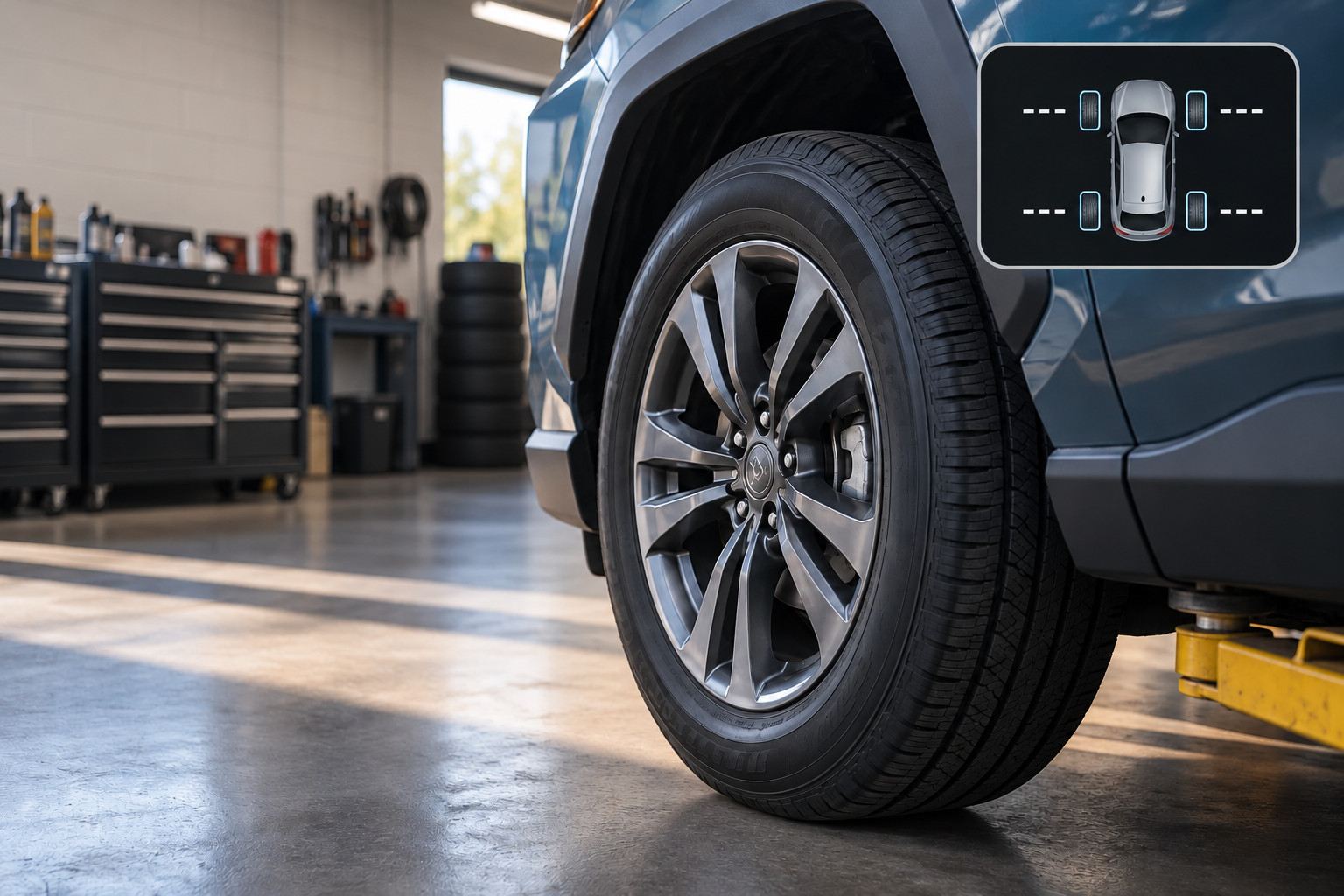
Ever had your Toyota’s tire pressures disappear after a tire rotation? Instead of showing a pressure at each corner, the display may show dashes. It can look like something is wrong with the car, but on certain newer Toyotas, it is part of a normal process: the car is figuring out where the tires have moved.
The system is clever, and a little inconvenient. A tire rotation takes only a short time, but the vehicle may need 10–30 minutes of driving to identify its wheel positions. Here’s what is happening, and how to tell the difference between a normal relearn and a problem that needs repair.
Why does the display show dashes after a tire rotation?
The tire-pressure sensors move with the wheels. After a rotation, the right-front sensor may now be at the right rear, for example. Its identification number has not changed, so the car still knows which sensor is transmitting. It just needs to learn where that sensor is now installed.
On the 2024 RAV4 Hybrid, Toyota specifies tire-pressure initialization after rotation. This clears the old position information and starts automatic wheel-position identification. While the system determines the new locations, the display can show dashes instead of the four pressure readings.
Toyota specifies driving at 25 mph (40 km/h) or faster for approximately 10–30 minutes to allow the positions to be identified. Some variation in wheel speeds during normal driving—including turns—helps distinguish the wheels. The warning lamp flashes three times when initialization is started; that is not the same as a TPMS malfunction warning.
Quick answer: Dashes shortly after a tire rotation can be normal. The car may simply be learning the four wheel positions. If the display does not return after an appropriate drive, the system deserves a closer look.
How does the car know which tire is where?
Each wheel contains a battery-powered sensor that measures tire pressure and temperature and transmits a unique identification code. On RAV4s with individual tire-pressure displays, the vehicle also uses information about wheel rotation to match each sensor to a physical wheel location. It does this without a dedicated receiving antenna at each corner.
First, how does a sensor measure wheel rotation?
Here’s the surprising part: gravity. Imagine a tiny accelerometer inside the tire-pressure transmitter, rotating with the wheel. Centrifugal acceleration is nearly constant when the wheel turns at a steady speed, but gravity always points toward the ground. As the transmitter rotates, the direction of gravity relative to the sensor changes.
At the bottom of the wheel, gravity adds to the reading along one sensor axis. At the top, it subtracts. Halfway between the top and bottom, its contribution is zero. The result is a repeating rise-and-fall pattern. Timing one complete pattern gives the time required for a wheel revolution—its rotational period. That’s another way to describe wheel speed; the period can be converted to RPM.
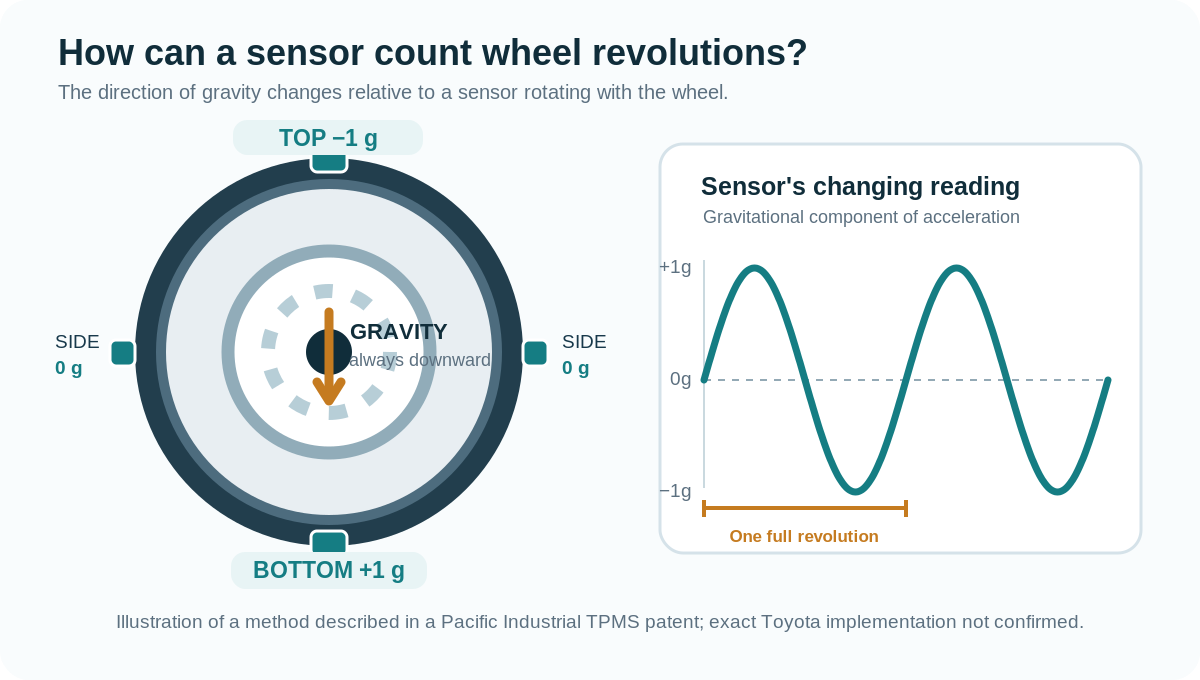
Pacific Industrial, an original-equipment TPMS supplier, published a patent describing this technique. It shows how a tire-pressure sensor can measure its own rotational period. Toyota has not disclosed the full production algorithm used in every vehicle, so we cannot say that the patent describes every detail of a particular RAV4.
Then it compares the tire sensors with the ABS wheel-speed sensors
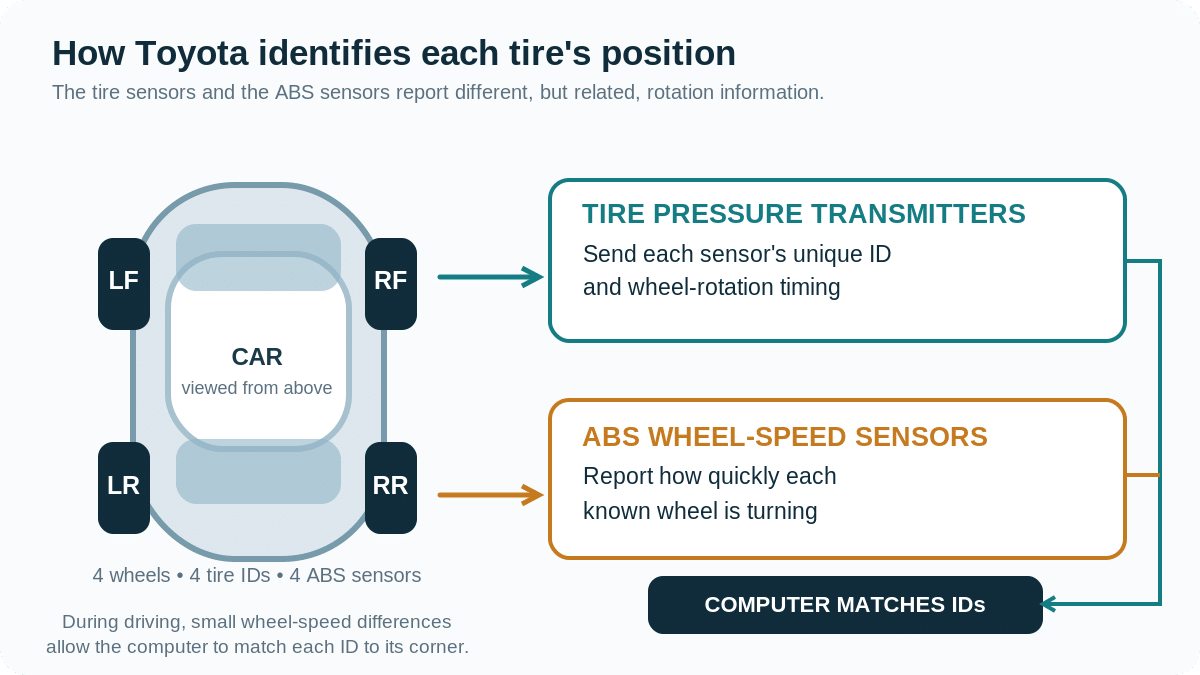
The ABS computer already knows the speed of each wheel because it has a separate wheel-speed sensor at each corner. Toyota’s TPMS computer receives those wheel-speed signals and compares them with the rotational information received from the tire-pressure transmitters.
The four wheels do not always rotate at exactly the same rate. In a turn, for instance, the outside wheels travel farther than the inside wheels. Over time, the computer can correlate each transmitter’s information with one of the four ABS wheel-speed signals and assign that transmitter to the correct position. Toyota documents this comparison; the exact software algorithm is not published in the New Car Features description.
Do you need to reprogram the sensors after a rotation?
Usually not. A tire rotation does not change the sensors’ identification numbers. The vehicle just needs to establish the updated positions, and on the 2024 RAV4 Hybrid that process is initiated by the Set Pressure function. The tires must first be adjusted to their specified cold pressures.
Replacing a sensor is different. A replacement must transmit the correct information and have an ID the vehicle recognizes. A compatible programmable sensor can sometimes clone the original ID, but compatibility also matters for the automatic-position feature. Receiving a pressure reading does not necessarily prove that a replacement sensor supports every position-identification function.
When is it a problem rather than a normal relearn?
- Dashes after a recent rotation: These can be normal while the car determines the new positions.
- The pressures never return: Incomplete initialization, a transmitter problem, or a position-identification problem may need diagnosis.
- The TPMS warning light blinks for about a minute and then stays on: Toyota identifies that pattern as a malfunction, not the three-flash acknowledgment of initialization.
- One tire reads incorrectly or a corner never updates: A technician can compare registered sensor IDs, measured pressures, communication data, and wheel-position information.
We don’t think a 10–30 minute road test should automatically become an expensive addition to every routine tire rotation. On models that allow the automatic relearn to finish during normal customer driving, we can explain why dashes are temporarily displayed, provided the system has been initialized correctly and there are no other symptoms.
Toyota TPMS service in Berkeley
At Art’s Automotive in Berkeley, we service Toyota and other Japanese vehicles, including their electronic systems. We check tire-pressure transmitter communication, use Toyota diagnostic equipment when needed, and register or replace compatible TPMS sensors. On supported vehicles, a scan tool can also manually write the wheel positions rather than relying entirely on a driving relearn.
If you need new tires, a sensor replacement, or diagnosis of a tire-pressure display that will not recover, our Berkeley tire-service page explains what we offer. Contact us to arrange an appointment.
Printable TPMS Technician Cheat Sheet
For technicians, we’ve prepared a two-page quick reference covering TPMS initialization, sensor ID registration, tire rotation, and wheel-position identification. It’s based on the fifth-generation Toyota RAV4 and RAV4 Hybrid. Procedures may vary on other Toyota models.
Download TPMS Technician Cheat Sheet (PDF)
Further reading
- How tire-pressure sensors work — our general TPMS explanation.
- RAV4 Hybrid maintenance — additional Toyota maintenance information.
- Toyota owner’s manuals — year- and model-specific owner instructions.
- Pacific Industrial patent US10160270B2 — an accelerometer-based method of measuring wheel rotation.
Applicability: This article is based primarily on the fifth-generation Toyota RAV4 / RAV4 Hybrid (2019–2025), especially the 2024 model. Other Toyota vehicles with individual tire-pressure displays may use different sensors, software, or service procedures. Always consult the manual for the specific vehicle.