If your car won’t start, the battery may be bad, or it may simply be discharged because of a charging problem or a key-off drain. At Art’s Automotive in Berkeley, we use battery testing methods that account for those differences, rather than relying on automated testing or blindly following procedures.
An automotive battery is expected to fail with 3-5 years, so people sometimes just replace the battery based on their hunch. But the battery isn’t always bad. Sometimes it’s just discharged due to another issue like key off drain or a charging system fault.
If you want your car fixed the first time, charging the battery (if necessary) and testing is the best course of action. These are things mechanics learn to do very early in their career, and it’s considered simple low-level work. You just connect the charger or tester and turn it on, right?
But you know what? It’s not actually all that simple. There’s a lot of the “well it has always worked for me” mentality in the industry and replacing a good battery doesn’t generally lead to a comeback.
Summary:
- A dead battery is not always a bad battery
- A discharged battery should be charged before testing, even w/IR testers
- Freshly charged batteries can test better than they really are
- Mechanics can make mistake that cause inaccurate test results
- Automatic battery testers can make mistakes that cause inaccurate test results
- A no-start problem may be the battery, charging system, or a key-off drain
- We test with those issues in mind instead of relying on automated battery testing
Today there are two approaches: modern automated testing/charging and traditional manual testing/charging. Neither one is foolproof. Both have issues and can lead to unnecessary battery replacement or fool you into thinking a bad battery is OK.
What Can Cause a “Dead Battery”
Before we begin talking about the pros, cons, and potential pitfalls of the various methods of battery charging and testing, let’s take a moment to talk about what might cause the symptoms often described at a “dead battery”. Normally when people say their battery is dead, they mean the car doesn’t crank. This can be caused by:
- A bad battery
- A discharged battery (due to an issue with drain or with the charging system)
- An issue with battery cables or terminals
- A blown main fuse
- A problem with the starting system
- A problem with the immobilizer system
Manual Battery Charging
Old fashioned manual battery chargers are still sold for a reason. They work perfectly well even though they may lack some of the de-sulfation routines and other features smart chargers have. However, YOU are the smart part of the charger. A manual battery charger will happily destroy your battery or cause it to explode in your garage. You need to know what you’re doing.
There are only two control knobs on a manual charger. A timer dial and an amperage dial. You decide how many amps to push into the battery and how long you want to do it for. Here’s the issue — the battery only has room for so many amps, and the charger will keep adding more whether there’s room or not.
The dangers of manual charging
What happens if you keep “filling” the battery when it’s already full? The best case is that you damage the battery. The worst case is that the hydrogen gas builds up and the battery explodes spraying acid everywhere.
We have several 10/40A battery chargers. Before charging you need to know “how full” the battery already is. This is known as “state of charge” or SOC%.

Checking state of charge
In the old days we’d check the SOC% using a hydrometer, a tool that measures the specific gravity of the electrolyte (battery acid) in the battery. The specific gravity correlates to the SOC%. Unfortunately, modern batteries are sealed and there’s no way to test the electrolyte.
To check the state of charge of a sealed battery, we use the static voltage. Static voltage is the voltage of the battery when it’s not being loaded. The battery’s just sitting there. The car’s not running. No electrical accessories are on. If you measure the voltage while the battery is at rest, that’s static voltage.
Using static voltage isn’t as good an indicator of SOC% as specific gravity because the battery needs to be “rested” for it to be accurate. If you check voltage after driving the car into the shop, the SOC% based on static voltage will appear higher than it really is. If you check static voltage after cranking the engine, the SOC% will appear lower than it actually is.
Below is the reference chart we use at the shop to avoid doing a bunch of math every time we want to charge a battery with a manual charger. It’s always OK to undercharge a battery. A 12V battery at 75% SOC will start the car and is charged enough for reliable manual battery testing, which we’ll cover in the next section.
Key takeaway: Manual charging is still a great way to charge a battery, but only if the person understands how to evaluate state of charge and calculate the correct charge time for the rate of charge.
12V Starting Battery Charge Time Chart
Average battery assumed: 500 CCA, approximately 50 Ah. Static voltage values assume a rested battery near 80°F / 27°C.
| State of Charge (SOC) | Static Voltage* | 10A Charge Time (total minutes) | 40A Charge Time (total minutes) |
|---|---|---|---|
| 0% | 11.8–11.9 V | 360 | 90 |
| 25% | 12.0 V | 270 | 70 |
| 50% | 12.2 V | 180 | 45 |
| 75% | 12.5 V | 90 | 25 |
| 100% | 12.7–12.75 V | 0 | 0 |
*Static voltage is only an approximation of state of charge and is most accurate on a rested battery. A recently charged or recently loaded battery may give a misleading voltage reading.
Manual Battery Testing
Manual battery testing is called “load testing” and it is the gold-standard of automotive battery testing.
Gold standard? Great! That’s the test to use, right?
It is the best test, but it’s easy to do improperly and get an erroneous result. Just like manual charging, YOU are the smart part of the tester.
First, the battery’s SOC% is critical. It must be between 75% and 100%. If it’s lower than 75% SOC%, then you may get a false “fail” result.
On the other hand, if the battery was just recharged it may pass the load test even though it’s bad. So, to summarize, you need to recharge the battery before load testing, but if you recharge the battery and test it, it may pass the test even though it’s bad. Simple right?
The solution is to recharge the battery and then remove the surface charge by leaving the headlights on for 3 minutes following charging. This is how you get an accurate result with a load tester.
The final issue with load testing is that you need to compensate for the battery’s temperature. A very cold battery may appear to fail when it’s just fine and a very warm battery may pass when it should fail.
What Is A Battery Load Test?
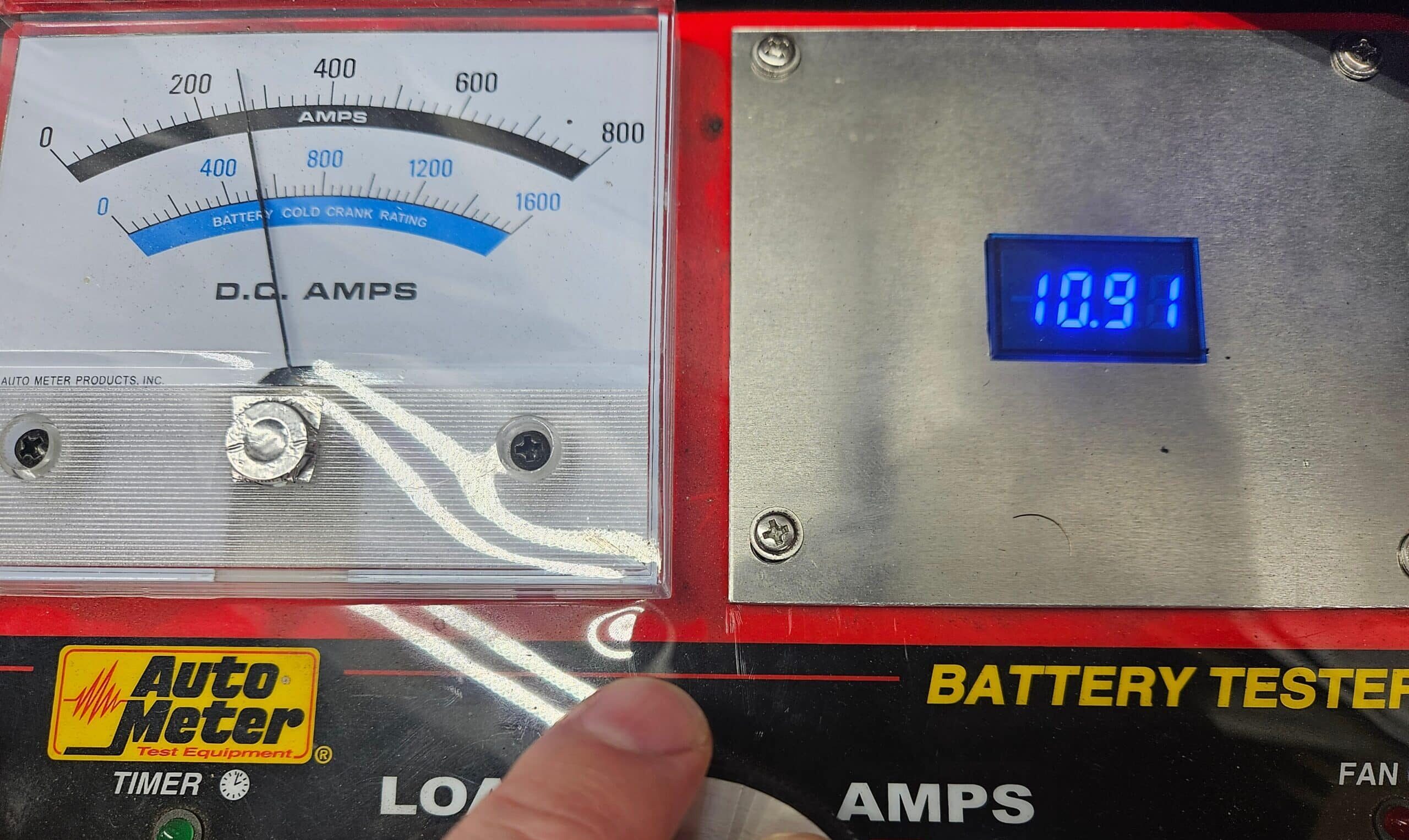
A battery load tester has two gauges and one control knob. One gauge displays amperage, the other displays voltage. The mechanic uses the knob to apply a load to the battery. When the knob is twisted a carbon pile inside the tester is compressed. This causes current to flow from the battery through the tester. As the battery strains to provide the requested current, its voltage drops.
The SAE (Society of Automotive Engineers) created a standard for testing 12V automotive batteries. When loaded at 1/2 its CCA (cold cranking amps) rating, a good battery should be able to maintain a voltage of 9.6V or higher at 70F after 15 seconds of loading.
Key takeaway: Load testing is still the best way to test a 12V battery, but only after proper charging and surface charge removal, and only when done with the correct load for 15 seconds and applying temperature compensation to the result.
Modern / Smart Battery Chargers
Smart battery chargers offer a lot of advantages. We own and use several, but we still have several manual battery chargers. Why?
Let’s start with what’s good about smart chargers.
- They won’t damage a battery, no matter how stupid the user is
- They default to slower charge cycles to preserve battery life
- They have de-sulfating cycles to break up sulfation and can sometimes recover batteries that might otherwise need replacement
- They will safely charge flat-plate AGM batteries
- You can hook it up and walk away. No math. No checking to see if the battery was fully charged
- They usually have a built-in power supply for maintaining 13.5V for reprogramming and other shop operations
What are the issues with smart chargers?
- It may take 4 or more hours to charge a battery. This can lead to cars not being done at the end of the day.
- They sometimes refuse to charge a battery
- They have software bugs and some models will just stop charging
- The models that do battery testing wrongly condemn batteries that are good and pass batteries that are bad.
People usually want their cars back same day. Not every car can be started at 8AM, and generally customers don’t want to hear that we haven’t started diagnosis because the battery hasn’t finished charging yet.
Mechanics don’t have patience for chargers that refuse to charge. Frequently a smart charger won’t charge because the static voltage is 10.5V because it assumes a dead cell (Each cell is 2.1V. There are 6 cells, so the battery voltage is 12.6V. If a fully charged battery had one bad cell, the voltage would be 10.5V (12.6 – 2.1 = 10.5). Here’s the thing — a discharged battery with 6 cells at 1.75V is also 10.5V and should be charged and tested.
Similarly, if a charger just stops charging for some unknown reason, it’s pretty frustrating when you discover it after leaving the battery to charge for 3 hours.

Key Takeaway: Simple and safe to use, and offers some useful features, but often too slow and buggy for use in a busy shop environment.
Modern / Smart Internal Resistance Battery Testers
The OEMs (Toyota, Subaru, Honda, and Mazda) all moved to internal resistance testers, usually made by Midtronics. I understand why. I imagine it’s very frustrating warrantying batteries that are perfectly good. You’ll remember that I said that replacing a good battery generally doesn’t lead to a comeback. However, if you’re a manufacturer and you start checking the “bad” batteries you paid to warranty, you may start looking for a solution.
At first, I liked internal resistance testers, but with some experience I started to see their flaws.

Let’s start with what’s good about smart battery testers
- Virtually no training or knowledge needed to use the tester
- Small and lightweight. Very portable
- Many print a “receipt” with test results
- They can be used to test discharged batteries (supposedly), saving a lot of time.
- They absolve the shop of responsibility for due diligence. “I plugged the tool in, and it said bad.”
Are internal resistance or Conductance testers Better?
Like nearly every tool, application dictate utility. Internal resistance testers can be fooled in some of the same ways as humans using manual load testers. You might even say that they replace human error with machine error. Mechanics are often busy, and quick battery tests are sometimes used in ways that can produce misleading results, but automation doesn’t eliminate mistakes.
Smart testers struggle with the same issues that cause problems with manual testing. When testing a discharged battery, the error rate is about 50%. You may as well flip a coin.
The tester is likely to say the battery is bad when it is actually good when a battery is tested in a discharged state. So, no problem. Just charge the battery before testing. However, if a battery has just been recharged the tester is far more likely to say the battery is good when it is actually bad.
I’ve never seen an IR tester say, “Hmm. I’m not sure. You should charge the battery and test again”. Or “Remove the surface charge and test again”. Smart testers are pretty much binary — good or bad. There is no nuance or self-doubt.
We’ve been doing this for a long time and we’re pretty confident that we’re more likely to get it right than a smart battery tester, and we’re certainly more willing to verify our conclusion with some additional testing.
Internal resistance testers aren’t useless; I’d just argue that they shouldn’t be used for diagnosing problems. I think they’re fine to use during preventive maintenance, when a battery isn’t likely to be discharged or freshly recharged. I think they’re fine for workers at auto parts stores and tow truck drivers without training. However, once a customer has a problem, load testing should be used for diagnosis.
IR / Conductance tester takeaway: Useful for quick screening, less trustworthy for diagnosis, especially when the battery is discharged or freshly charged.
When you might need more than just a battery test
Generally, we do a complete starting and charging system inspection whenever there’s an issue. It’s possible to have more than one problem. You might have a bad battery plus another issue. If we just test the battery, find it’s bad and replace it, you could be back in a couple days if you also have a key off drain.
That said, sometimes customers are pretty sure their issue is just a battery, and we’ll be happy to test just the battery as long as you’re not going to get mad at us if it turns out to have another issue that went undiagnosed.
Our philosophy
We are not anti-technology. We continually invest in tooling and training to keep up with constantly changing automotive technology. However, just because something is newer doesn’t necessarily mean it’s better for every situation, and we believe battery chargers and testers used in the 1930s still have a place in our shop today. We just need to apply our knowledge and experience when using them.
We know about the potential pitfalls when charging or testing batteries and we adjust our test methods to avoid errors. We’d rather spend a little more time getting the diagnosis right than replace a battery you did not need or miss a charging or drain problem that will leave you stranded again next week.
Need help with a battery, charging, or no-start problem in Berkeley or the East Bay?
If you’re in Berkeley, Albany, El Cerrito, Oakland, or nearby and you’re tired of guesswork, we can determine whether your problem is the battery itself, the charging system, or something draining the battery while the car is parked. If you don’t live in the Bay Area, I hope you found this page interesting or useful.