
Most vehicles aren’t actually due for a large service at 100,000 miles, contrary to popular opinion. Depending on the year and model, the items due at exactly 100K may be little more than routine oil service, tire rotation, and a few inspections. Many Toyotas also require their first coolant replacement. The more important questions are what was due before 100K, what is coming due soon, how old the car is, and what work has already been performed.
Customers frequently call us and say something like, “My car is ready for its big 100,000-mile service” and they’ll ask questions like, “What’s included in a 100K service”, and “how much will it cost?”. When I get one of these calls, I know the answer will not fit into a quick price quote and I’m going to need to spend a bit of time on the phone. What the car needs depends on the exact vehicle and its maintenance history. The answer is not as straightforward as you might think.
The internet is full of pages with lists of all of the service items that should be included with “the big 100,000 scheduled maintenance” and what it should cost.
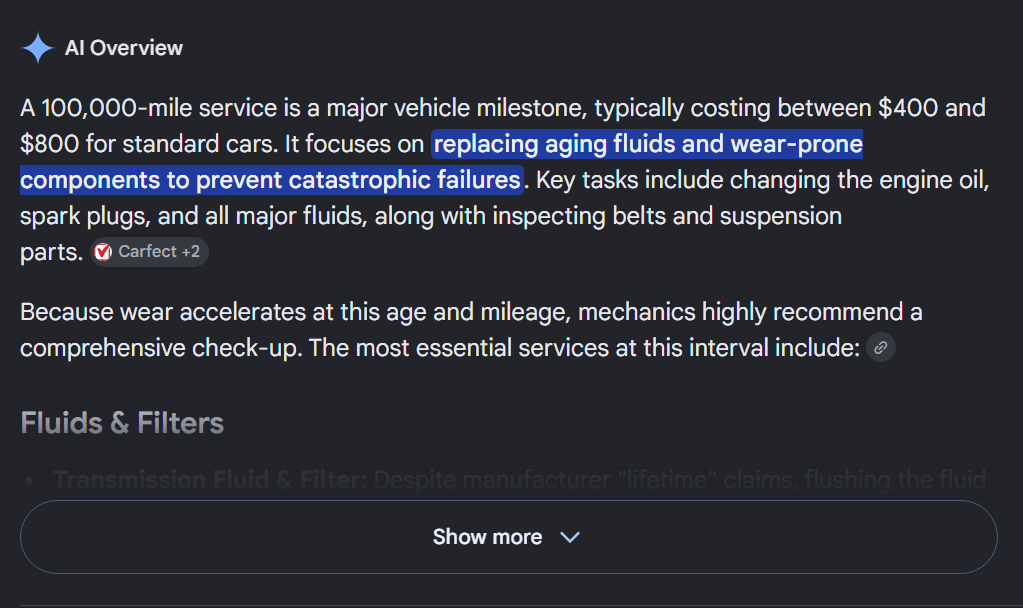
Google’s AI overview will happily deliver an authoritative sounding summary of what you should be doing and why.
But here’s the thing. In my view the majority of the top search results are inaccurate, at least for the cars that we repair (Toyota, Subaru, Honda, and Mazda).
There isn’t really a big service due at 100K. For most cars all that’s due is an oil change and tire rotation. But how can that be possible? 100,000 miles is a lot right? I’ll explain.
Is there really a 100,000-mile service?
I get it. It seems like 100K miles should be a milestone. It’s a big round number. Maybe a little like hitting 50 years old. It just seems significant.
Now, I don’t mean to say that there aren’t some major services due around 100K. Major maintenance may be scheduled near 100K at 90K, 105K, 120K, depending on the vehicle. And to be fair, Toyota does recommend the first engine coolant change at 100K on some models. However, for the most part, there isn’t a big service due at 100K.
Why Do So Many Shops advertise “100K Mile service packages”?
At this point the 100K service has inertia. It’s a body in motion and hard to stop.
I think that’s the primary reason you’ll see so much information about it online. Put yourself in a shop owner’s shoes. Would you want to be the shop that doesn’t offer a service people are looking for? The customer is always right. Right? Just put together a package and a price and when someone asks for it you offer it. Make it big because that’s what it’s supposed to be. Just check on Google and you’ll see that’s what people are saying.
And that’s not necessarily a bad thing. If a shop decides to create a 100K service package with the 90K items, 105K items, or 120K items depending on the make and model, it will get the right stuff, maybe a little early or late, but that’s not a huge deal.
I don’t really have a problem with shops that just roll with the 100K but try to do the service work the car actually needs. It’s just not our style. We’d rather spend a little extra time explaining things. We believe that time spent educating our customers about the service and repair needs pays off in the long run.
Is a 100,000 mile service necessary?
For most of the cars we service, there is a service due at 100K, but it’s usually small. If you have a Toyota, Subaru, Honda, or Mazda, you will likely need a small service at 100K. However, there are some major service intervals surrounding 100,000 miles.
What might be due around 100,000 miles?
| Item | When it might be due | Is it actually due? |
|---|---|---|
| Spark plugs | Common intervals include 60K, 75K, 105K, and 120K | Depends on engine and plug specification |
| Timing belt | Some engines use approximately 105K intervals | Many engines have timing chains, but for those with a belt, use the manufacturer’s mileage and age recommendation. |
| Engine coolant | Toyota commonly uses 100K initially, then every 50K. Honda is often due at 90K. | Age and coolant type also matter |
| Transmission fluid | Manufacturers intervals range from 30K to “never”. | On most vehicles, we recommend replacing the transmission fluid well before 100K, even when the manufacturer does not provide a normal-service interval. |
| Brake fluid | Some manufacturers recommend every 2-3 years or 30K miles. Others don’t recommend replacing the fluid at all. | We recommend replacing brake fluid at least every 3 years or 30K. Brake fluid condition can be tested. |
| Differential/transfer fluid | Manufacturer’s gear oil intervals vary widely, and not all cars have transfer cases or separate differentials. | We recommend replacing gear oil every 30K, or at minimum every 60K. |
| Valve clearance | Older Honda models required valve adjustment every 15K. Modern Honda cars have a 105K interval. Many cars have self-adjusting valves or very stable valve clearance. | We recommend setting the interval based on a combination of the manufacturer’s recommendation and our experience with the particular engine. |
| Air and cabin filters | Generally recommended every 30K, so air filters would normally be part of both the 90K and 120K. | Air filter life depends on the work it’s made to do. 30K is adequate for most people, but one trip to Burning Man can clog your filters in a day. |
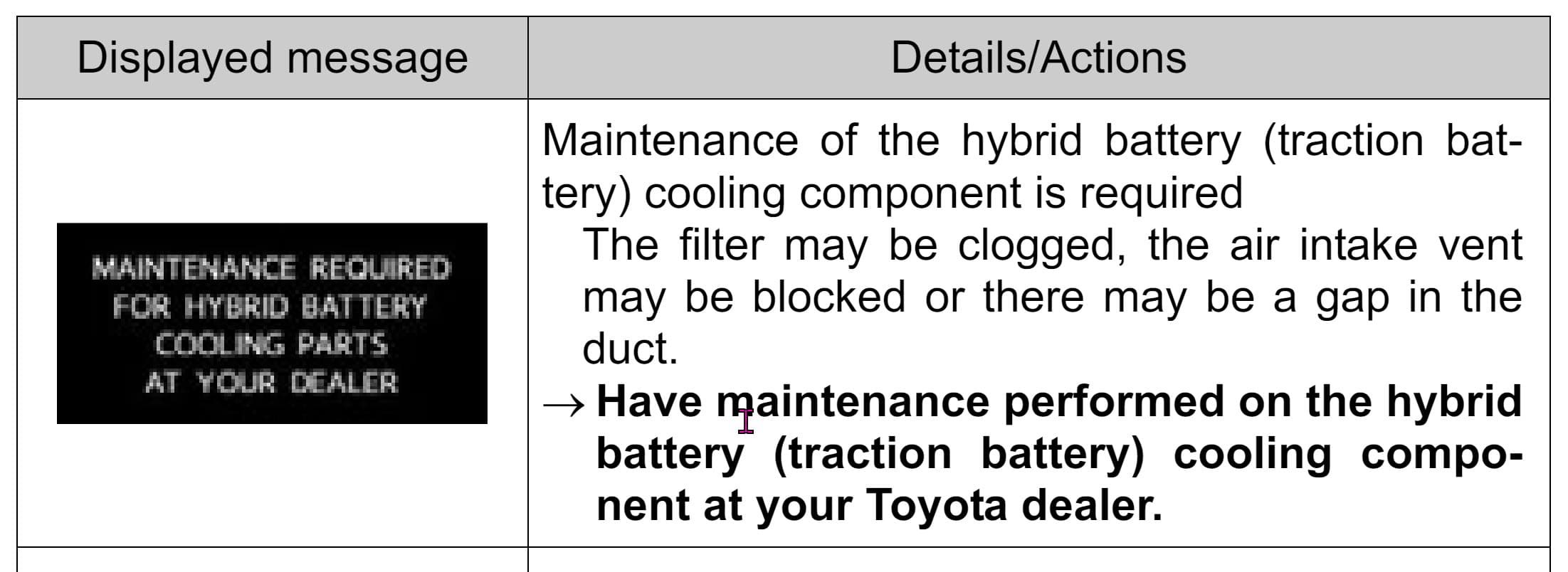
| Hybrid battery cooling filter | This is usually a “check” item for Toyota hybrids every 30K. | We generally recommend hybrid filters every 30K for most people. |
Toyota, Honda, Subaru, and Mazda differences
We have a dedicated page covering preventative maintenance for each of the makes we service. I’d recommend checking the page for your make to come up with a service plan. We’re also happy to talk about it on the phone or in person. If we don’t have the service history for your car, it’s helpful if you bring it with you to the shop or email it to us.
Toyota maintenance schedules and service recommendations
Subaru maintenance schedules and service recommendations
Honda maintenance schedules and service recommendations
Mazda maintenance schedules and service recommendations
Official Maintenance Schedule Information From the Manufacturers
| Manufacturer | Public link | Where the schedule is found |
|---|---|---|
| Toyota | Toyota Manuals and Warranties | Select the year and model, then open the Warranty & Maintenance Guide. That document generally contains the actual mileage/time schedule; the regular owner’s manual usually does not contain the complete schedule. (Toyota) |
| Subaru | Subaru Vehicle Resources | Select the vehicle and look for the Warranty & Maintenance Booklet. Subaru puts the schedule near the back of that booklet. The documents themselves are hosted publicly on Subaru’s Technical Information System domain. (Subaru) |
| Honda | Honda Owner’s Manual & Warranty Lookup | Select the year and model. Older Hondas have a conventional mileage-and-time maintenance schedule in the owner’s manual. Maintenance Minder vehicles instead provide the service-code definitions and supplementary time-based instructions in the maintenance section. The public lookup currently covers U.S. models back to 1980. (Honda Owners) |
| Mazda | Mazda Manuals, Guides and Maintenance Schedules | Select the year and model. Mazda normally provides an owner’s manual and, for many models, a separate Scheduled Maintenance PDF or maintenance section. The current selector covers U.S. vehicles back to model year 2000. (Mazda USA) |
What if the service history is unknown?
So, what if you just bought the car or just don’t know its service history? Which service should you choose at 100K?
I’d recommend starting with some investigation and then making a decision. You don’t need to pick a service package to start. If you have some service records, we’ll review them first, but if not, it’s not a big deal. We can start with the inspections and let you know what we find. We check the condition of most service items when we do a full vehicle inspection in addition to checking the car’s overall condition.
- Motor oil – check for a lube sticker and check the level and condition of the oil.
- Brake fluid – brake fluid can be tested for moisture content and copper content.
- Gear oils – a history is always preferred, but there are signs of degradation we can use to make a recommendation
- Transmission fluid – many units are sealed and not that easy to do a quick check on, but if the history is unknown it’s worth taking the time.
- Coolant – we can test coolant concentration and PH and make a recommendation
- Spark plugs – on most cars it’s not too difficult to remove a single spark plug to inspect. There are some exceptions though.
- Timing belt – most cars have timing chains these days, but if equipped, we’ll look for a mileage sticker and other signs
- Valve adjustment – there’s no good way to know for sure, but we look for signs the valve cover hasn’t been removed in a long time. Not all cars need periodic valve adjustments.
Why generic 100,000-mile service checklists can be misleading
One highly ranked 100K-service checklist claims that virtually every vehicle needs a major service around 100,000 miles. It presents fluid flushes, spark plugs, and timing-belt replacement as broadly applicable items and makes technically questionable statements such as “stale coolant loses its ability to transfer heat”.
The 100K list they provide doesn’t match any manufacturer’s service that I’m aware of. Carfect is a used-car sales and financing business, not a vehicle manufacturer or professional repair shop, yet their results are one of the first things you’ll find if you search and is cited in Google’s AI overview.
What I’m saying is that there are a lot of pages with a lot of wrong answers written by people who are great at SEO, but know nothing about the subject they’re writing about. Then Google search summaries repeat the same wrong information and pop it up on the top of the search results as if it’s fact.
How much does a 100,000-mile service cost?
You’ve probably guessed the answer to this question already. It depends.
At Art’s Automotive, if the vehicle needs only its routine oil service, tire rotation, and inspection, the visit currently costs around $150 as of 2026. However, your car may need something different at 100K. Maybe you missed the 90K. Maybe you have a Toyota and want to replace the coolant (although we usually recommend testing and then waiting to 120K if it tests OK).
If you want to email in your service records and VIN, we’d be happy to make you an exact estimate. Although I’ll add the caveat that what the car looks like on paper and what it looks like in person is sometimes different.
What Should You Do at 100K miles?
If you had only read a different page about 100K services, you would now have a solid plan. You’d have a list of service items you could get quotes on from different shops.
But unfortunately, you read this page, and now you’re probably not sure what to do. Like many things in life, there is no one right answer for everybody. However, if you want to avoid over-maintaining or under-maintaining your car, you’ll need to do a little research or rely on a professional you trust for the answer.
If you want to figure it out on your own, your owner’s manual is a good place to start. It has a description of each preventative maintenance interval with all of the required items. You’ll need to look for any items from previous intervals that you may have missed too though.
When you have that as a base, ask some mechanics. You’ll find different opinions about additional service that should be performed. You’ll need to make a judgement on who to trust. Don’t be afraid to ask why you should be doing something or what would happen if you skipped it.
If you’re near Berkeley, CA, you’re welcome to call, email, or come in and we’d be happy to review your service records and then give you our opinions and pricing.