
This is the story of a 2007 Toyota Avalon and the diagnosis our lead tech Morgan struggled through. This Avalon had a very intermittent overheating problem. Pink coolant spray under the hood was pretty good proof our customer had a real problem, but the fault was very difficult to duplicate, it took many hours of running in the bay for it to appear the first time.
When the failure finally occurred, the engine cooling fan did not come on as coolant temperature rose. At the same time, the temperature gauge dropped to cold. Cycling the ignition off and back on restored normal operation every time.
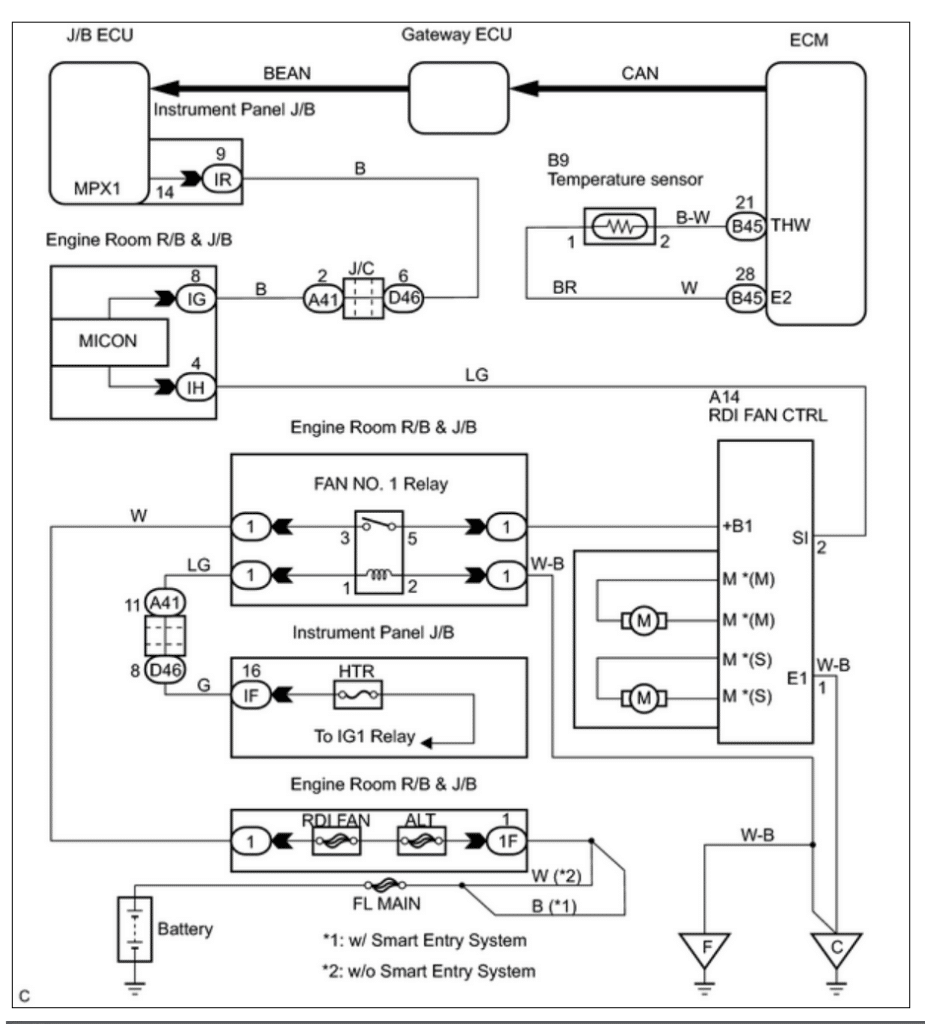
The temperature sensor itself was not the main suspect because the temperature gauge, cooling fan operation, and scan-tool communication with the ECM were all affected at the same time.
On this vehicle, the ECM monitors coolant temperature and transmits that information over the CAN network. The Gateway then passes temperature information to the body/combination meter via the BEAN network, and the cooling fan control also depends on ECM-originated coolant temperature data. If the ECM stops communicating on CAN, the temperature gauge can drop out and the cooling fan command can be lost.
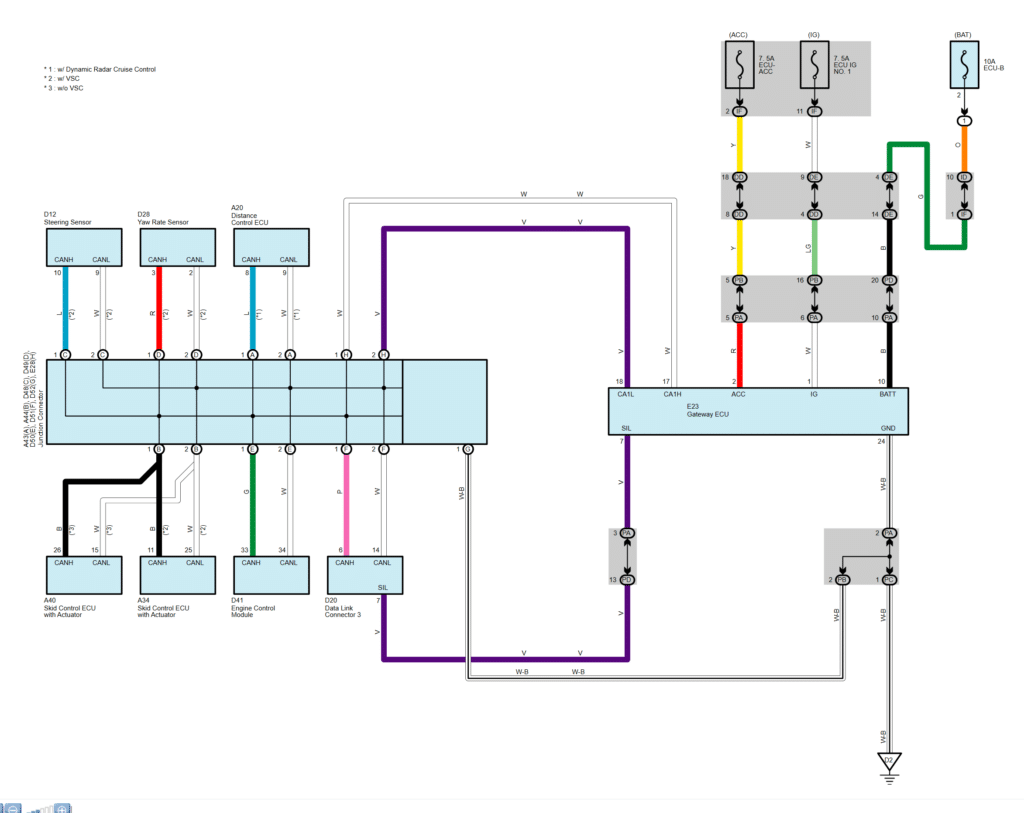
During the failure, both OE and aftermarket scan tools lost communication with the ECM. The ABS ECU set a CAN communication code every time the problem occurred. Using the GTS+ CAN bus utility, all expected modules were visible except for the ECM. This initially made the ECM look like the most likely fault.
To check the CAN wiring, the CAN signal was scoped at both the ECM connector and the DLC at the same time. The signal was identical at both locations, proving that the CAN wiring between the ECM and DLC was not open or shorted while the symptoms were present. ECM powers and grounds were also verified. At that point, the diagnosis still seemed to point toward an ECM communication failure.
We replaced the ECM with a used unit because a new unit wasn’t available (and our customer might not have been willing to pay for a new ECM even if it had been available). We let the car run while monitoring it, and much to our surprise, it wasn’t fixed.
It didn’t make sense. When the issue occurred, we couldn’t communicate with the ECM with a scan tool, the CAN H and CAN L waveforms were identical at the ECM and the DLC on a dual trace scope, we could communicate with the ABS ECU, and the ECM’s powers and grounds were fine. How was that not an ECM?
The actual fault turned out to be the terminating resistor inside the ABS ECU.
With the ABS ECU removed and measured directly between CAN-H and CAN-L, resistance was about 114 ohms, which is normal for a single CAN terminating resistor. However, tapping the unit or pressing lightly on the circuit board caused the resistance to go open. Disassembly of the ABS ECU showed that the connection from the CAN terminal to the circuit board was not secure. The connection was welded rather than soldered, and one of the jumper connections was effectively just resting on the pad. Light pressure on that jumper caused the terminating resistor connection to drop in and out.
Here’s what we think was happening. When that terminating resistor intermittently opened, the CAN network became unstable. The ABS ECU logic allowed it to continue working, even with a sloppy signal. However, the ECM logic appears to be far more fragile. I think that when the ECM sees an issue with the network, it just gives up and stops communicating. It still functions; it monitors sensors and drives outputs and the car keeps running, but it doesn’t try to talk or listen on the CAN bus.
So, when we scoped the CAN bus and saw a normal CAN waveform, the intermittent issue with the terminating resistor had already come and gone. The network issue was “fixed”, but the ECM had stopped trying. This is why the problem resolved every time the car was turned off and restarted. With each key cycle the ECM woke up fresh, having forgotten about the network issue and willing to try talking and listening again.
The repair was replacement of the ABS ECU. After replacement, the overheating, temperature gauge dropout, and ECM communication loss were resolved.
The important lesson from this one is that a CAN termination problem can make another module look guilty. In this case, the ECM disappeared from the network, but the root cause was an intermittent terminating resistor connection inside the ABS ECU. Since there isn’t complete documentation for control unit logic, you usually won’t know what a unit will do in a situation unless you’ve tested it in the past. The black box is going to do whatever it was designed to do.
By the way, I have seen similar intermittent CAN termination failures in Bosch ABS control units on Subaru vehicles as well, though with different symptoms and a less convoluted diagnostic path, so if you’re having network issues on an old car with a Bosch ABS actuator, tap testing while checking the terminating resistor with an ohmmeter might be a worthwhile test.
And if you have a 2005-2012 Avalon with a temperature gauge that drops to cold and then the car overheats, I hope this made your day a little easier.
Art’s Automotive is an independent auto repair shop in Berkeley, California, specializing in Toyota, Honda, Subaru, and Mazda service and repair, with particular expertise in hybrid diagnosis and repair. We have served the East Bay since 1980.
Call 510-540-7093 to request an apppointment